Unauthorized copying, distribution, modification, or commercial use of this website or its contents is strictly prohibited without express written permission.
Contact: markwipfler2@gmail.com
This notice will close in 30 seconds
3x3x3
Mark Anthony Wipfler's Cube Timer
SAVED!
ALARM! ALARM!
Click to stop the alarm!
Select Language
Settings
100%
Settings save automatically when changed
Set Alarm?
7:00 AM
Select days
No label
Next alarm: Select days to see
:
The alarm voice will speak whatever you type!
Your Alarms
MASTULATER - Algorithm Translator
The Master Translator of Cube Algorithms
?
INPUT ALGORITHM
Scramble: F2 D L2 U2 B U' L' D2 L F2 L B' U R D L' B R D' L'
?
PAUSED - Data saved on your device | You can switch cubes/activities - time preserved | Resume: P | Stop: Space
0.00
Progress Chart - Last 100 Solve Times
?
????
?
Current Time:Loading...
?
The Universal Core: Every algorithm on any twisty puzzle derives from these patterns. Master Sune and Anti-Sune. The chunked structure (4-move sequences) enables muscle memory and lightning-fast execution. Works on all cube sizes for OLL (Orient Last Layer).
Sune
Core
U R U' RU R2 U'
Anti-Sune
Core
U' R' U R'U' R2 U
Double Sune
Master Algorithm
U R U' RU R' U' RU R2 U' R2
Anti-Double-Sune
Master Algorithm
U' R' U R'U' R U R'U' R2 U R2
The "Anti" Principle
U becomes U' (and vice versa)
R becomes R' (and vice versa)
R2 and U2 stay the same (180° rotations are their own inverse)
Keep the same sequence - finger tricks and rhythm preserved
Result: Perfect mirror that undoes the original algorithm
Session Average (All Solves):1:03.22
Average of Last 5 Solves (Ao5) - Removes Best & Worst:1:13.76
Average of Last 12 Solves (Ao12) - Removes Best & Worst:1:02.47
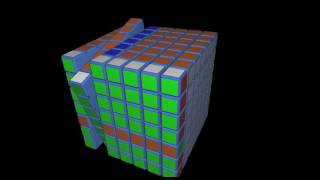
5x5x5 Edge Flip Parity Lw' U2 Lw' U2 F2 Lw' F2 Rw U2 Rw' U2 Lw2
* Notation Breakdown (standard for 5x5 to keep it simple):
* Lw': Turn both left layers (outer + inner) together counter-clockwise. (Wide turn.)
* U2: Turn the top outer layer twice (180 degrees).
* F2: Turn the front outer layer twice.
* Rw: Turn both right layers (outer + inner) together clockwise.
* Rw': Turn both right layers counter-clockwise.
* Lw2: Turn both left layers twice (180 degrees).
5x5x5 Edge Switching/Flipping Parity u 3u' R U R' F R' F' R u' 3u
* Notation Breakdown (standard for 5x5 to keep it simple):
* u: Turn the second upper layer clockwise.
* 3u': Turn the third upper layer (middle) counter-clockwise.
* R: Turn the right outer layer clockwise.
* U: Turn the top outer layer clockwise.
* R': Turn the right outer layer counter-clockwise.
* F: Turn the front outer layer clockwise.
* F': Turn the front outer layer counter-clockwise.
* u': Turn the second upper layer counter-clockwise.
* 3u: Turn the third upper layer clockwise.
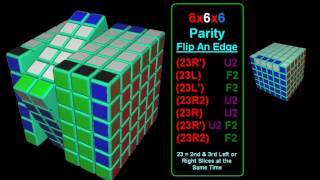
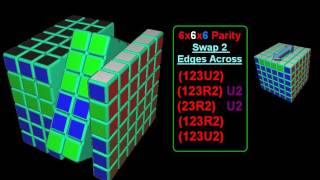
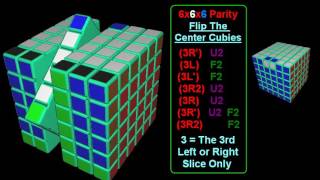
* Notation Breakdown (standard for 6x6 to keep it simple):
* 3r2: Turn the third right layer (inner) twice (180 degrees).
* U2: Turn the top outer layer twice.
* 3Uw2: Turn the top three layers (wide) together twice.
* 3u2: Turn the third top layer (inner) twice.
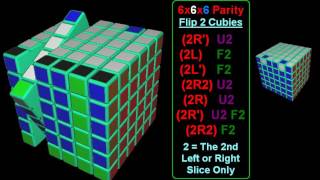
6x6x6 Dredge FLIP PLL Parity
2r' U2 2l F2 2l' F2 2r2 U2 2r U2 2r' U2 F2 2r2 F2
* Notation Breakdown (standard 6x6 notation):
* 2r': Turn the two inner-right layers counter-clockwise.
* U2: Turn the top layer 180 degrees.
* 2l: Turn the two inner-left layers clockwise.
* F2: Turn the front face 180 degrees.
* 2l': Turn the two inner-left layers counter-clockwise.
* F2: Turn the front face 180 degrees.
* 2r2: Turn the two inner-right layers 180 degrees.
* U2: Turn the top layer 180 degrees.
* 2r: Turn the two inner-right layers clockwise.
* U2: Turn the top layer 180 degrees.
* 2r': Turn the two inner-right layers counter-clockwise.
* U2: Turn the top layer 180 degrees.
* F2: Turn the front face 180 degrees.
* 2r2: Turn the two inner-right layers 180 degrees.
* F2: Turn the front face 180 degrees.
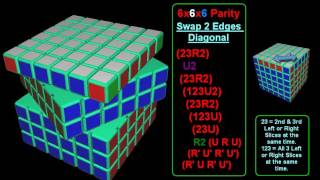
6x6x6 Adjacent Edge Swap PLL Parity (R' U R U') 3r2 U2 3r2 3Uw2 3r2 3u2 (U R' U' R)
* Notation Breakdown (standard for 6x6 to keep it simple):
* R': Turn the right outer layer counter-clockwise.
* U: Turn the top outer layer clockwise.
* R: Turn the right outer layer clockwise.
* U': Turn the top outer layer counter-clockwise.
* 3r2: Turn the third right layer (inner) twice (180 degrees).
* U2: Turn the top outer layer twice.
* 3Uw2: Turn the top three layers (wide) together twice.
* 3u2: Turn the third top layer (inner) twice.
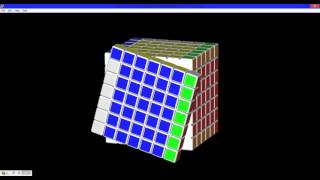
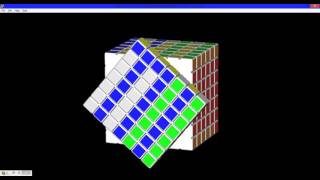
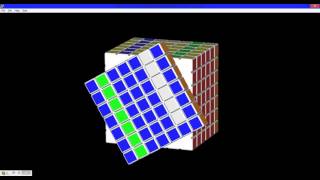
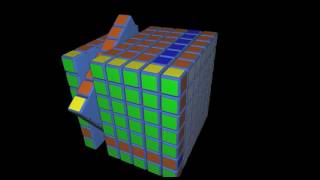
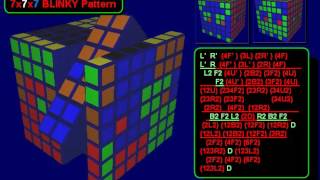
7x7x7 Edge Flip Parity 3Lw' U2 3Lw' U2 F2 3Lw' F2 3Rw U2 3Rw' U2 3Lw2
* Notation Breakdown (standard for 7x7 to keep it simple):
* 3Lw': Turn the third left layers (wide inner) counter-clockwise.
* U2: Turn the top outer layer twice.
* F2: Turn the front outer layer twice.
* 3Rw: Turn the third right layers (wide inner) clockwise.
* 3Rw': Turn the third right layers counter-clockwise.
* 3Lw2: Turn the third left layers twice (180 degrees).
7x7x7 Edge Switching/Flipping Parity 3u 4u' R U R' F R' F' R 3u' 4u
* Notation Breakdown (standard for 7x7 to keep it simple):
* 3u: Turn the third upper layer clockwise.
* 4u': Turn the fourth upper layer (middle) counter-clockwise.
* R: Turn the right outer layer clockwise.
* U: Turn the top outer layer clockwise.
* R': Turn the right outer layer counter-clockwise.
* F: Turn the front outer layer clockwise.
* F': Turn the front outer layer counter-clockwise.
* 3u': Turn the third upper layer counter-clockwise.
* 4u: Turn the fourth upper layer clockwise.
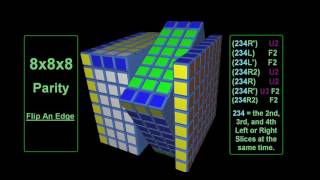
8x8x8 Opposite Edge Swap PLL Parity 4r2 U2 4r2 4Uw2 4r2 4u2
* Notation Breakdown (standard for 8x8 to keep it simple):
* 4r2: Turn the fourth right layer (inner) twice (180 degrees).
* U2: Turn the top outer layer twice.
* 4Uw2: Turn the top four layers (wide) together twice.
* 4u2: Turn the fourth top layer (inner) twice.
8x8x8 Dredge FLIP PLL Parity
To "flip one dredge" (a single wing edge pair parity error) on a 8x8x8 without rotating the cube,
you can use the following algorithm, which involves only inner and outer layer turns:
3r' U2 3l F2 3l' F2 3r2 U2 3r U2 3r' U2 F2 3r2 F2
* Notation Breakdown (standard 8x8 notation):
* 3r': Turn the three inner-right layers counter-clockwise.
* U2: Turn the top layer 180 degrees.
* 3l: Turn the three inner-left layers clockwise.
* F2: Turn the front face 180 degrees.
* 3l': Turn the three inner-left layers counter-clockwise.
* F2: Turn the front face 180 degrees.
* 3r2: Turn the three inner-right layers 180 degrees.
* U2: Turn the top layer 180 degrees.
* 3r: Turn the three inner-right layers clockwise.
* U2: Turn the top layer 180 degrees.
* 3r': Turn the three inner-right layers counter-clockwise.
* U2: Turn the top layer 180 degrees.
* F2: Turn the front face 180 degrees.
* 3r2: Turn the three inner-right layers 180 degrees.
* F2: Turn the front face 180 degrees.
8x8x8 Adjacent Edge Swap PLL Parity (R' U R U') 4r2 U2 4r2 4Uw2 4r2 4u2 (U R' U' R)
* Notation Breakdown (standard for 8x8 to keep it simple):
* R': Turn the right outer layer counter-clockwise.
* U: Turn the top outer layer clockwise.
* R: Turn the right outer layer clockwise.
* U': Turn the top outer layer counter-clockwise.
* 4r2: Turn the fourth right layer (inner) twice (180 degrees).
* U2: Turn the top outer layer twice.
* 4Uw2: Turn the top four layers (wide) together twice.
* 4u2: Turn the fourth top layer (inner) twice.
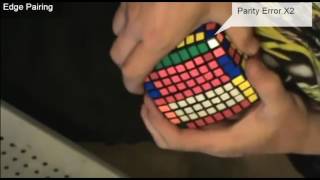
9x9x9 Edge Flip Parity 4Lw' U2 4Lw' U2 F2 4Lw' F2 4Rw U2 4Rw' U2 4Lw2
* Notation Breakdown (standard for 9x9 to keep it simple):
* 4Lw': Turn the fourth left layers (wide inner) counter-clockwise.
* U2: Turn the top outer layer twice.
* F2: Turn the front outer layer twice.
* 4Rw: Turn the fourth right layers (wide inner) clockwise.
* 4Rw': Turn the fourth right layers counter-clockwise.
* 4Lw2: Turn the fourth left layers twice (180 degrees).
9x9x9 Edge Switching/Flipping Parity 4u 5u' R U R' F R' F' R 4u' 5u
* Notation Breakdown (standard for 9x9 to keep it simple):
* 4u: Turn the fourth upper layer clockwise.
* 5u': Turn the fifth upper layer (middle) counter-clockwise.
* R: Turn the right outer layer clockwise.
* U: Turn the top outer layer clockwise.
* R': Turn the right outer layer counter-clockwise.
* F: Turn the front outer layer clockwise.
* F': Turn the front outer layer counter-clockwise.
* 4u': Turn the fourth upper layer counter-clockwise.
* 5u: Turn the fifth upper layer clockwise.
10x10x10 Opposite Edge Swap PLL Parity 5r2 U2 5r2 5Uw2 5r2 5u2
* Notation Breakdown (standard for 10x10 to keep it simple):
* 5r2: Turn the fifth right layer (inner) twice (180 degrees).
* U2: Turn the top outer layer twice.
* 5Uw2: Turn the top five layers (wide) together twice.
* 5u2: Turn the fifth top layer (inner) twice.
10x10x10 Dredge FLIP PLL Parity
To "flip one dredge" (a single wing edge pair parity error) on a 10x10x10 without rotating the cube,
you can use the following algorithm, which involves only inner and outer layer turns:
4r' U2 4l F2 4l' F2 4r2 U2 4r U2 4r' U2 F2 4r2 F2
* Notation Breakdown (standard 10x10 notation):
* 4r': Turn the four inner-right layers counter-clockwise.
* U2: Turn the top layer 180 degrees.
* 4l: Turn the four inner-left layers clockwise.
* F2: Turn the front face 180 degrees.
* 4l': Turn the four inner-left layers counter-clockwise.
* F2: Turn the front face 180 degrees.
* 4r2: Turn the four inner-right layers 180 degrees.
* U2: Turn the top layer 180 degrees.
* 4r: Turn the four inner-right layers clockwise.
* U2: Turn the top layer 180 degrees.
* 4r': Turn the four inner-right layers counter-clockwise.
* U2: Turn the top layer 180 degrees.
* F2: Turn the front face 180 degrees.
* 4r2: Turn the four inner-right layers 180 degrees.
* F2: Turn the front face 180 degrees.
10x10x10 Adjacent Edge Swap PLL Parity (R' U R U') 5r2 U2 5r2 5Uw2 5r2 5u2 (U R' U' R)
* Notation Breakdown (standard for 10x10 to keep it simple):
* R': Turn the right outer layer counter-clockwise.
* U: Turn the top outer layer clockwise.
* R: Turn the right outer layer clockwise.
* U': Turn the top outer layer counter-clockwise.
* 5r2: Turn the fifth right layer (inner) twice (180 degrees).
* U2: Turn the top outer layer twice.
* 5Uw2: Turn the top five layers (wide) together twice.
* 5u2: Turn the fifth top layer (inner) twice.
Smart Perpetual Calendar
Month Due: $0.00
Month Paid: $0.00
YTD Paid: $0.00
Mon
Tue
Wed
Thu
Fri
Sat
Sun
Manage Birthdays
Add New Birthday
Spending Tracker -
?
How to add expenses: Click on any calendar day, then enter expenses with amounts (e.g., "Rent $1000 due" or "Electric $85 paid")
Total: $0.00
How the Spending Tracker Works
How to Add Expenses to Calendar:
Click on any calendar day to add or edit notes. Type your expense with a dollar amount and include the word "due" or "paid".
Examples of what to type:
RENT $1,000 due
Phone bill $50 paid
Internet $60 due
Electric $85.50 paid
Month Due: $0.00
Shows the total of all expenses marked with "due" in the current month.
The system searches your calendar notes for the word "due" (not case-sensitive)
Any dollar amount on the same line as "due" gets added to Month Due
Example: If you type "RENT $1,000 due" on Jan 1st, January's Month Due = $1,000
This shows what bills need to be paid this month
Month Paid: $0.00
Shows the total of all expenses marked with "paid" in the current month.
The system searches your calendar notes for the word "paid" (not case-sensitive)
Any dollar amount on the same line as "paid" gets added to Month Paid
Example: Change "RENT $1,000 due" to "RENT $1,000 paid" after you pay it
Shows how much you've actually spent this month
YTD Paid: $0.00
Shows the Year-To-Date total of all expenses marked "paid" from January 1st until now.
Every expense marked "paid" in the current year is counted
Great for tracking your total annual spending
Resets to $0.00 on January 1st each year
Example: $1,000/month paid for 6 months = $6,000 YTD Paid
Pro Tips:
Update "due" to "paid": When you pay a bill, click the day and change the word
Not case-sensitive: "DUE", "due", "Due" all work the same way
Multiple expenses per day: Put each on its own line in the note
Track everything: The more you track, the better budget insight you get
Unauthorized copying, distribution, or use of this code is strictly prohibited.
Timer & Solving Help
How to Use the Timer
Press and hold SPACEBAR to start inspection time (15 seconds default). Release spacebar to begin solving. Press spacebar again to stop the timer.
Inspection Time
Inspection lets you examine the scrambled cube before starting. The timer shows a 15-second countdown. If you exceed 15 seconds, you get a +2 penalty (DNF at 17 seconds).
Pause & Resume
Press P key to pause the timer mid-solve. Press P again to resume. Great for taking breaks during long solves.
Delete Times
Click any time in your solve list to delete it. Useful for removing mis-starts or invalid solves.
Keyboard Shortcuts
SPACEBAR - Start/stop timer, begin inspection
P - Pause/resume timer
Alarm Clock Help
Setting an Alarm
Click Alarm Clock button. Select hour, minute, AM/PM. Choose which days (Mon-Sun). Add optional label. Click + Set Alarm.
Alarm Sounds
Alarms play cycling beep tones at maximum volume. Custom voice message speaks your alarm label using text-to-speech.
Voice Settings
Choose from your system's available voices. Adjust pitch (0.0 = deep, 2.0 = high), rate (0.5 = slow, 2.0 = fast), and volume.
Managing Alarms
All set alarms appear in the "Your Alarms" list. Click Edit to modify. Click Delete to remove. Toggle switch to enable/disable.
Stopping Alarms
When alarm triggers, the screen flashes red with "ALARM! ALARM!" text. Click the huge STOP ALARM button to silence it.
Important Notes
Browser must stay open for alarms to work
Check browser permissions for sound
Alarms saved to localStorage (persist after refresh)
Calendar & Expense Tracking Help
Adding Expenses
Click any day on the calendar. Enter expense amounts and click DUE or PAID to track bill status. Changes auto-save instantly.
Expense Categories
Pre-set categories: Rent, Water, Internet, Electric, Insurance, Car Payment, Car Insurance, Phone, Gas, Groceries, Other.
DUE vs PAID Buttons
DUE - Red button, marks bill as unpaid/due
PAID - Green button, marks bill as paid
CLEAR - Orange button, removes the expense entry
Clicking a button shows checkmark and auto-saves
Standard Notes
Add any text notes to calendar days. Click Save Note to store it. Use Clear Note to remove.
Spending Totals
Month Due - Total unpaid bills this month
Month Paid - Total paid bills this month
YTD Paid - Year-to-date total paid (Jan 1 - now)
Managing Birthdays
Click Manage Birthdays button. Enter name, year, month, and day. Birthdays appear automatically on the calendar each year.
Paycheck Tracking
Click Paycheck Stats to log paychecks. Enter date, pay rate, net pay, gross pay, hours, and taxes. View averages and history.
Auto-Save Notice
Yellow text says "All changes below are auto saved" - this means expense buttons (DUE/PAID/CLEAR) save immediately. No Save button needed!
MASTULATER - Algorithm Translator Help
What is MASTULATER?
MASTULATER (Master Translator) removes confusing x y z cube rotations from algorithms, converting them into pure face moves (R L U D F B) that are easy to film for YouTube videos.
WHAT THIS DOES:
Converts M, E, S (middle slice) moves to standard notation
Converts x, y, z (cube rotations) to standard notation
Shows CLEAR DIRECTIONS for every confusing move
Simplifies the output by canceling redundant moves
AXES GUIDE:
X axis = Left center → Right center (horizontal sideways)
Y axis = Bottom center → Top center (vertical pole)
Z axis = Back center → Front center (through your face)
How to Use
Type or paste your algorithm in the INPUT box
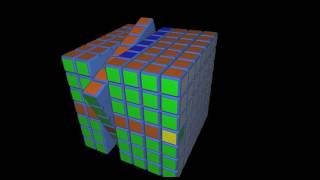
Press ENTER (or click ENTER button) to lock the algorithm
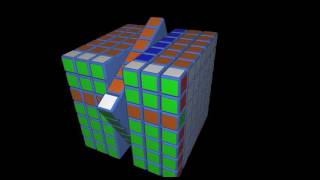
Choose a transformation:
Remove Cube Rotations (x y z) - Converts rotations to face moves
Inverse Algorithm - Reverses the sequence
Mirror L/R, F/B, or U/D - Flips the algorithm
Simplify/Optimize - Combines consecutive moves (U U = U2)
Each transformation creates a new OUTPUT box
You can edit and transform each OUTPUT box independently!
Supported Notation
Basic moves: R L U D F B (+ prime ' and 2)
Wide moves: Rw Lw r l (lowercase = wide)
Numbered wide moves: 3Rw 5Rw 4Uw (for big cubes)
Rotations: x y z (removed by translator)
Keyboard Shortcuts
ENTER - Lock algorithm and enable transformation buttons
SHIFT+ENTER - Add new line in text box
Why Use MASTULATER?
YouTube Video Production: Film smooth algorithms without rotating the cube mid-sequence
Accessibility: Makes algorithms readable for "common sense adults" who don't know x y z notation
Scale Production: Clean up messy algorithms from online sources quickly
Nested Transformations: Experiment with different versions until you find the perfect filmable sequence
Result: Filmable algorithm with no cube rotations - ready for YouTube!
Supported Puzzles
Works for all NxNxN cubes from 2x2x2 through 10x10x10. Does NOT support Pyraminx, Megaminx, Square-1, Skewb, or Clock (different notation systems).
Scrambles & Puzzles Help
Understanding Scrambles
Each scramble is a random sequence of moves that thoroughly mixes your cube. Follow the moves exactly as shown for an official random state.
Notation Guide
R - Turn right face clockwise
R' - Turn right face counter-clockwise (prime)
R2 - Turn right face twice (180 degrees)
U, D, L, F, B - Up, Down, Left, Front, Back faces
Rw, Uw - Wide turn (2 layers together)
x, y, z - Cube rotations
Selecting Puzzles
Click "Select Cube" button to choose from 50+ puzzles:
2x2 through 21x21 cubes
Pyraminx, Megaminx, Skewb
Square-1, Clock
4x4 BLD, 5x5 BLD (Blindfolded)
And many more!
Generating New Scrambles
Click "New Scramble" button to generate a fresh random scramble for your selected puzzle. Each scramble is WCA-standard.
Statistics & Progress Help
Understanding Averages
Best Time - Your single fastest solve ever
Ao5 - Average of 5 (removes best and worst)
Ao12 - Average of 12 (removes best and worst)
Ao100 - Average of 100 (removes best 5 and worst 5)
Why Remove Best/Worst?
This is the WCA standard. Removing outliers gives a more accurate picture of your true average speed, not just lucky or unlucky solves.
Progress Chart
The chart shows your last 100 solve times visually. Watch your times trend downward as you improve. Spikes indicate bad solves or mistakes.
Chart Features
Blue line shows your times
Lower is better (faster times)
Hover over points to see exact times
Updates automatically after each solve
Tracking Improvement
Focus on your Ao100 - it's the most reliable measure of your skill level. Single best times are exciting but inconsistent!
Sune Algorithms Help
What is Sune?
Sune is one of the most fundamental algorithms in speedcubing. It's used for orienting the last layer (OLL) and forms the foundation for many advanced algorithms.
Basic Sune
R U R' U R U2 R' (7 moves, order-2)
Orients 3 yellow edges on top layer while preserving corner positions.
Anti-Sune
R U2 R' U' R U' R' (7 moves, order-2)
Mirror of Sune. All moves are inverted (U becomes U', R becomes R') while maintaining the sequence structure.
Double Sune (Optimized)
R U R' U R U' R' U R U2 R' (11 moves, order-3)
Combines two Sune patterns with seam cancellation. Middle moves (R' + R) cancel out for efficiency.
The Anti Principle
To create the "Anti" version of any algorithm, flip all moves:
U becomes U'
U' becomes U
R becomes R'
R' becomes R
Seam Cancellation
When combining algorithms, opposite moves can cancel (R' + R = nothing) and similar moves can merge (U2 + U = U').
Copying Algorithms
Click any algorithm to copy it to your clipboard instantly. Paste it into your notes or practice apps.
Settings & Customization Help
Display Mode
Toggle between Timer Mode (focus on solving) and Chart Mode (see your progress graph). Timer mode hides unnecessary elements.
Inspection Time
Adjust from 0-30 seconds. Standard WCA competition uses 15 seconds. Set to 0 to disable inspection entirely.
Beep Volume
Control inspection countdown beeps. Slide from 0 (silent) to 100 (loud). Beeps play at 10s, 5s, and when inspection ends.
Color Cycling
The neon colors cycle automatically through the rainbow spectrum. This is always enabled for the signature aesthetic and cannot be disabled.
Language Selection
Click the long Language button to change interface language. 12 languages available: English, Español, Português, Français, Deutsch, 日本語, 中文, Русский, العربية, हिन्दी, 한국어, Italiano
GO!
YOUR CUSTOM ACTIVITIES
Create unlimited personal activities for timing chores, workouts, study sessions, etc.
Stopwatch
00:00:00.000
Ready
Lap Times
No laps recorded yet
BEST LAP
--:--
WORST LAP
--:--
AVERAGE LAP
--:--
TOTAL LAPS
0
Countdown Timer
00:05:00
Quick Countdown Presets
Where to Buy a 3x3x3
Click any store to open in a new tab - searches pre-filled for your puzzle!
Import/Export Mark's Cube Timer
Sync your data between computers using a USB stick or file transfer
Step 1: Name This Computer
Step 2: Export Data FROM This Computer
Download all your cube timer data as a file. Save it to your USB stick, then import on another computer.
Select what to export:
Export Summary:
Click "Preview Export" to see what will be exported
━━━ OR ━━━
Step 3: Import Data TO This Computer
Load data from another computer. Select the export file from your USB stick.
▲
Click to Select File or Drag & Drop
Accepts .json files exported from Mark's Cube Timer